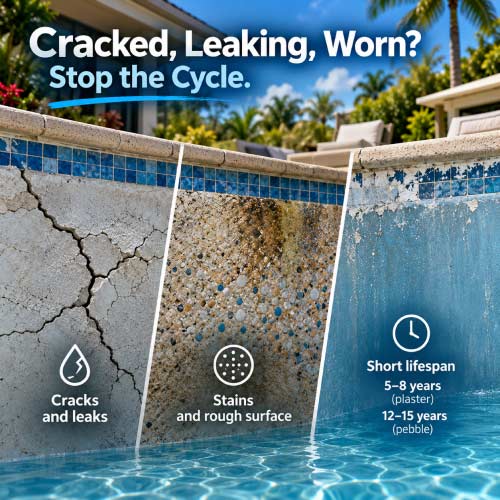
Cracked plaster and worn pebble finishes send most pool owners down the same path: drain the pool, tear out the old surface, and pay for another cement finish. That cycle works when the shell is sound and you only need a cosmetic refresh. It fails when the real problem is leaking, recurring cracks, staining, or a finish that will not last another Florida summer — a familiar cycle for an experienced Wellington pool contractor.
A 60-mil reinforced PVC membrane, such as Cefil, overlay is the other option. Instead of grinding off pebble or plaster and hoping the next coat lasts, you cover the existing bowl with a welded, flexible waterproof skin. For many cracked pools, that is the smarter repair.
What Tear-Out Really Involves
Traditional resurfacing means removing loose plaster or exposed aggregate, repairing visible cracks, and applying a new plaster or pebble coat. In Florida, standard plaster often lasts 5–8 years. Premium pebble can last 12–15 years if chemistry stays perfect.
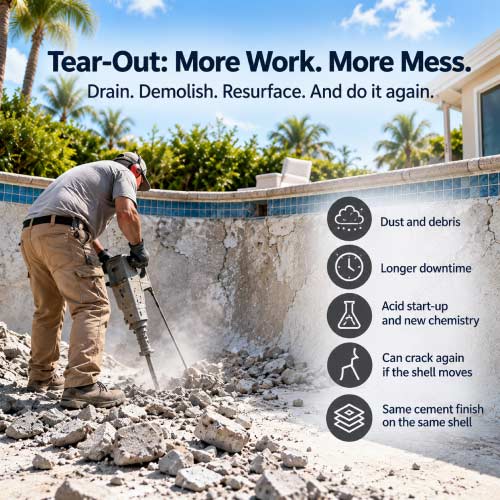
Tear-out still leaves you with a cement finish bonded to the same shell. Typical trade-offs include:
• Dust, demolition debris, and longer downtime
• Acid start-up and a new chemistry window
• Etching or staining if pH or calcium drifts
• A new coat that can crack again if the shell still moves or leaks
Tear-out makes sense when the structure is solid, the finish is only worn, and you specifically want a cement look. It is the wrong default when water is leaving the pool through the finish.
How a 60-Mil Overlay Works
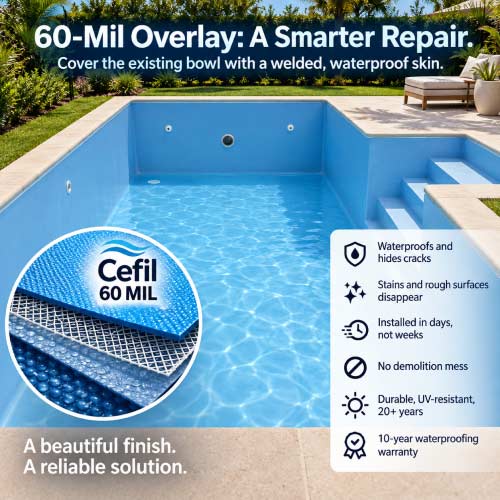
Cefil 60-mil membrane is a three-layer reinforced PVC sheet: PVC faces plus a polyester mesh core. Thickness is 1.5 mm — roughly three times a standard vinyl liner.
The installation sequence is straightforward:
- The pool basin is cleared of debris (if necessary, cosmetic repairs are made to the surface to remove any unevenness)
- A retaining profile is installed along the entire perimeter of the pool (along the upper edge)
- The membrane is cut to size on site and heat-sealed using hot air
- New skimmers, jets, bottom drains, and lights designed for this type of liner are installed (they are inexpensive)
The membrane does not rely on the old plaster or pebble for waterproofing. It becomes the barrier. Cracks stay under the liner. Stains disappear. Rough pebble is covered. The pool can return to service in days, not weeks.
SAKKO POOL supplies Cefil 60-mil membranes nationwide as the official U.S. representative and installs them on renovation and new ICF projects in Florida.
When Overlay Beats Tear-Out
Choose a 60-mil pool overlay when one or more of these apply:
• The shell is cracked, but still structurally usable. A new cement coat sits on the same movement. A reinforced membrane flexes and stays watertight.
• You have already resurfaced once — or twice. Repeat tear-outs add cost without changing the waterproofing strategy.
• The pool leaks. Cement finishes are not independent liners. A welded 60-mil sheet isolates water from the shell.
• Pebble is stained, rough, or shedding. You do not have to blast every stone off the wall to get a clean surface and a new color.
• You need speed and less mess. Overlay avoids full demolition of a still-serviceable finish — useful on tight lots, finished decks, and in-season reopenings.
• Chemistry has been hard to keep stable. Non-porous PVC does not etch like plaster, and algae has fewer pores to colonize.
• You are building new in ICF. SAKKO POOL pairs insulated concrete forms with the same Cefil 60-mil membrane: strong insulated shell, welded finish, no plaster schedule.
What Overlay Does Not Replace
A membrane is not a structural repair. Address these first:
• Collapsing or leaning walls
• Severe settlement
• Failed hydrostatic relief
• A bowl that cannot hold shape
Large loose sections of plaster or pebble should still be removed so the membrane sits on a stable base. Good prep matters. On a sound-enough shell, though, 60-mil reinforced PVC solves what owners actually feel: wet soil, rising water bills, stained walls, and a surface that keeps failing.
Durability, Look, and Cost Logic
Cefil membranes carry a 10-year waterproofing warranty and commonly last 20+ years with normal care. Practical advantages:
• Puncture and tear resistance from the polyester mesh core
• Heat-welded seams that stay flat and watertight
• UV-stable top coats that resist fading better than thin vinyl
• Collections from smooth unicolor to textured, non-slip stone looks
• Installation over concrete, gunite, plaster, pebble, tile, fiberglass, metal, and ICF
Installed overlay on a mid-size pool is typically a fraction of a full rebuild and often comparable to — or less disruptive than — a premium pebble tear-out. The payoff is different: an independent liner you can replace later without another attack on the shell.
That is why Olympic and commercial projects use the same class of membrane, and why remodelers can ship rolls and weld on site instead of waiting on a plaster crew.

Practical Decision
• Choose tear-out if the shell is dry, the cracks are cosmetic, and you are committed to another cement finish.
• Choose a 60-mil overlay if the finish is cracked or leaking, you want waterproofing that does not depend on plaster, or you are done paying for the same repair.
SAKKO POOL can inspect the bowl, recommend overlay versus structural work, supply Cefil 60-mil membrane anywhere in the United States, and install it on Florida renovations and new ICF pools.
Request a quote or call (561) 951-1201. Bring photos of the cracks. The right call is usually obvious once you look at the shell instead of only the surface.
Have Questions?
Talk to our specialist! Just fill out the form, and we’ll give you a call!
FAQ
Other articles on this topic
Custom Tanning Ledges: Why ICF + Cefil 60-Mil Beats Gunite & Thin Vinyl
Long-Term Pool Sustainability: ICF + Cefil 60-Mil for 20+ Years
Multi-Use Wellness Pools: ICF Structure + Cefil 60-Mil Membrane

Modern Pool Design: LED Lighting, Textures & 60-Mil Membranes

The True Cost of Owning a Pool: ICF & 60-Mil PVC ROI Explained