
South Florida pool buyers in 2026 are moving away from gas heaters. They want efficient electric heat pumps for the cooler months and reliable chilling capacity when July and August push water temperatures into the upper 80s. The insulation already built into an ICF shell changes the equipment equation more than most people realize. Once the walls and floor are thermally protected and the interior is finished with a thick Cefil 60 mil reinforced PVC membrane, heat no longer disappears into the plaster and the surrounding soil. That single change lets you specify smaller equipment that runs fewer hours and still holds a stable temperature day and night — a thermal advantage that any experienced Florida licensed pool builder can design into the system from the start.
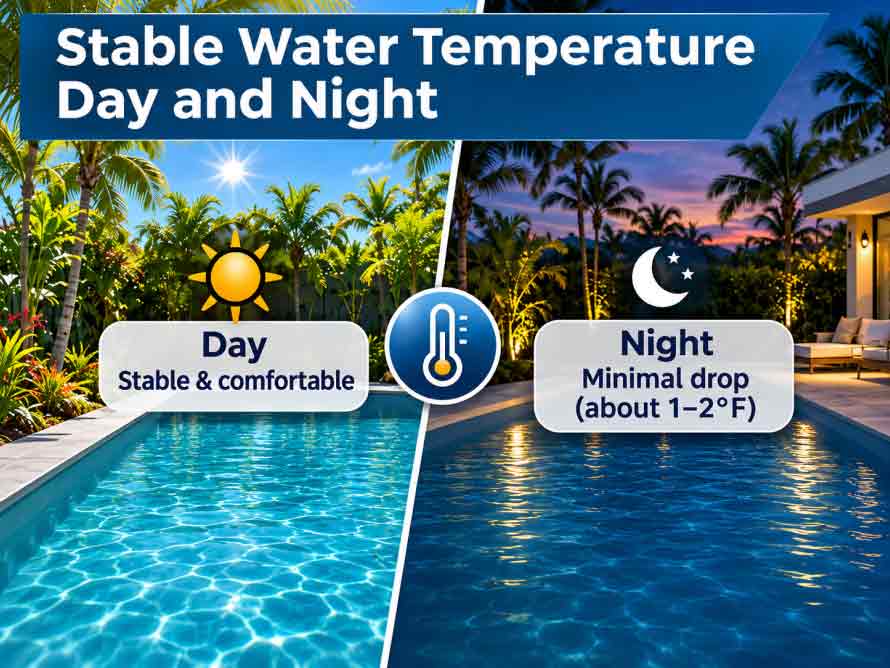
Traditional gunite or shotcrete pools lose a large share of their heat through the shell. Concrete is a good conductor. Overnight the ground pulls warmth out of the walls and floor, and the next morning the heater has to replace it. In an uninsulated shell the water temperature can drop several degrees between dusk and dawn, forcing the equipment to cycle hard. An ICF pool stops most of that transfer. The expanded polystyrene forms stay in place after the concrete is poured, creating a continuous insulated envelope with high R-value and almost no thermal bridging. Heat that would have migrated into the soil stays in the water. Nighttime temperature drops shrink dramatically, often to only a degree or two under normal conditions.
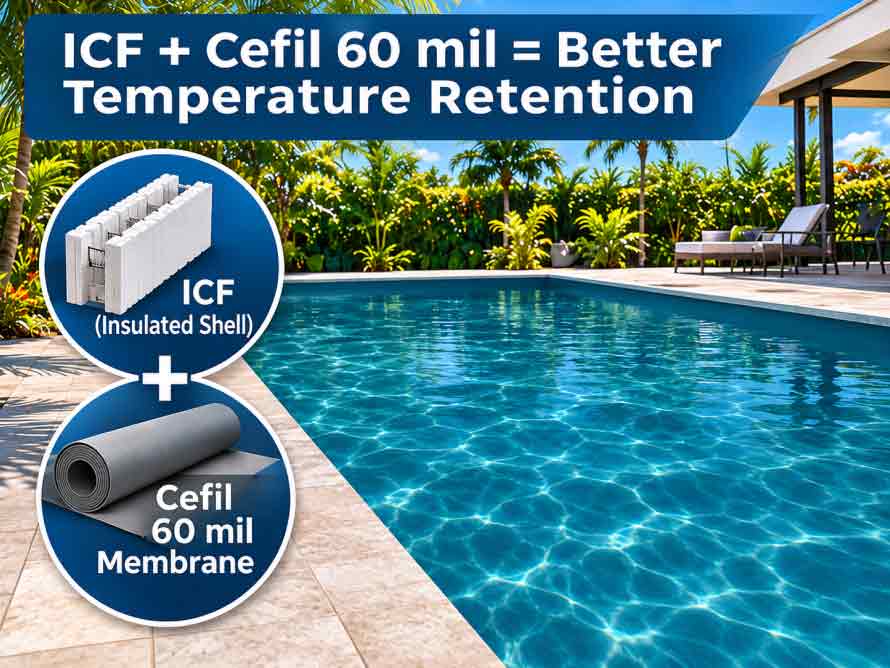
The Cefil 60 mil membrane adds a second, practical barrier — a custom pool liner welded to the exact shape of the pool. Unlike plaster, which can absorb and conduct heat, the welded PVC surface is impermeable. Heat does not soak into the finish or transfer into the concrete core the way it does with a traditional plastered shell. The membrane simply holds the water against the already-insulated structure. The result is a tighter thermal system: less heat leaves the pool, so less heat has to be added or removed by the equipment.
What This Means For Equipment Selection
Because the shell retains temperature so effectively, the heat pump or chiller does less work to maintain the setpoint. In practice this usually allows:
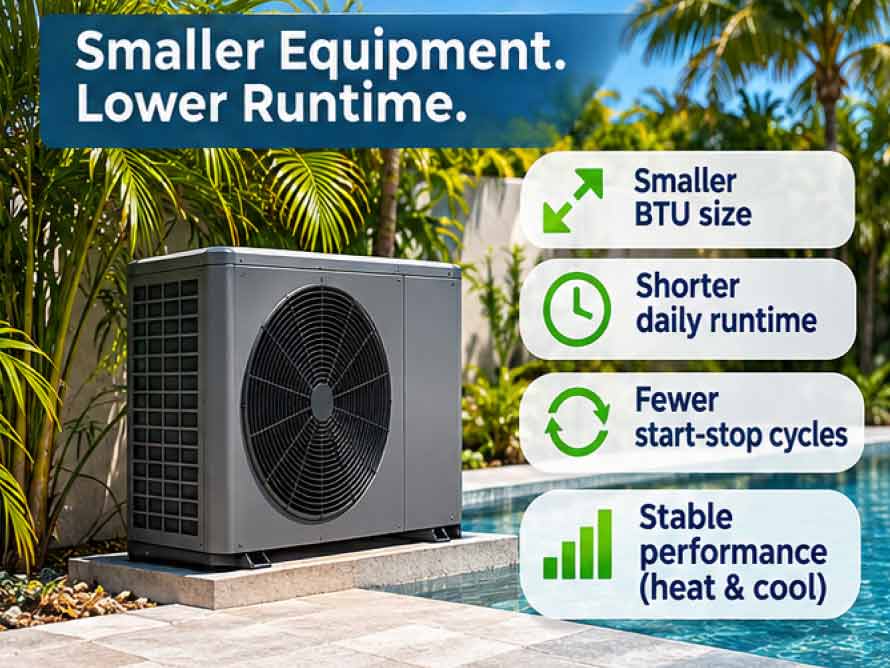
- A smaller BTU rating than the same volume pool built in uninsulated concrete. Many South Florida ICF projects can drop one size class compared with a conventional specification.
- Shorter daily runtime. The unit does not have to chase large overnight losses, so it spends more time at lower load or idle.
- Fewer start-stop cycles. Stable water temperature means the compressor runs longer at efficient loads instead of short, frequent bursts.
- More predictable performance with reversible heat-pump chillers. The same unit that adds heat on a cool evening can pull heat out on a hot July afternoon without fighting massive conductive losses.
Manufacturers size equipment primarily on surface area, desired temperature rise or drop, wind exposure, and ambient conditions. The standard formulas do not automatically credit an insulated shell. When the pool is built with ICF and finished with Cefil, experienced designers reduce the calculated load to reflect the lower heat loss. The outcome is equipment that is correctly matched rather than oversized “just in case.”
Stable Nights Change The Operating Pattern
In a typical uninsulated South Florida pool the water can cool enough overnight that the heat pump must run several hours each morning simply to recover. With ICF and the Cefil membrane that recovery is smaller. The pool holds temperature closer to the setpoint, so the equipment runs mainly to offset surface evaporation and the modest remaining losses. The same logic applies in reverse during peak summer. A chiller or heat-cool unit does not have to fight heat that is continuously entering through the walls; it only has to manage the solar and ambient load that reaches the water surface. The result is shorter runtimes and more stable water temperatures even when the equipment is set to a comfortable mid-80s range.
Practical Specification Notes For New ICF Pools
When you plan a new ICF pool with a Cefil 60 mil membrane, treat the thermal performance of the shell as part of the equipment design:
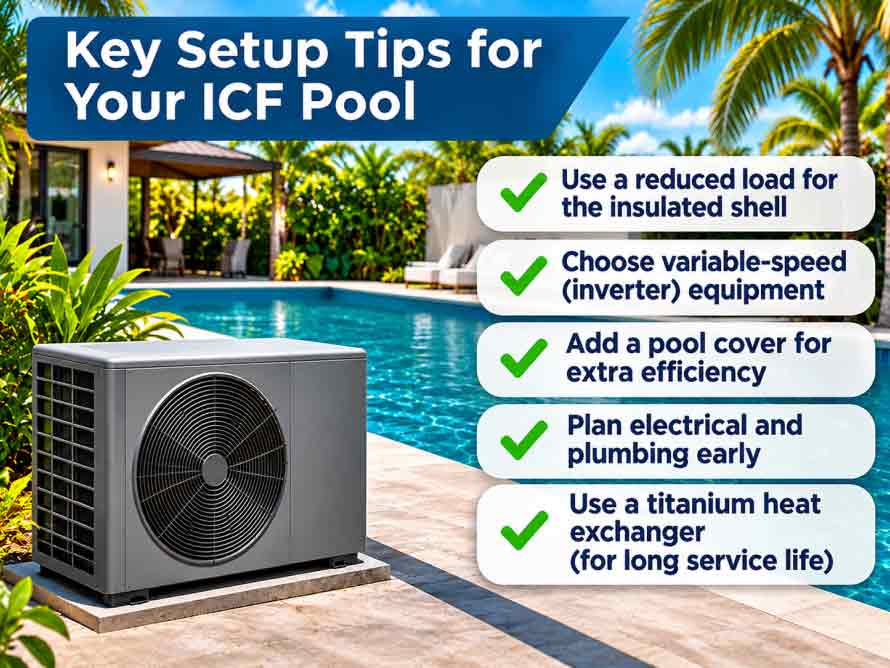
- Start with the manufacturer’s surface-area charts, then apply a realistic reduction for the insulated envelope rather than using the full uninsulated load.
- Prefer variable-speed or inverter heat pumps and chillers. They modulate output to match the lower, steadier load instead of cycling a large fixed-speed unit.
- Pair the equipment with a good cover strategy. The ICF shell already limits conductive loss; a cover further reduces evaporative loss and lets the smaller unit work even less.
- Confirm electrical and plumbing details early. A correctly sized unit often needs less breaker capacity and simpler piping than an oversized gas heater or large fixed-speed chiller.
- Choose titanium heat exchangers for longevity in salt or chemically treated water. The Cefil membrane is fully compatible with standard pool chemistry, so the equipment sees normal operating conditions without special constraints.
South Florida’s mild winters make heat pumps especially attractive once the shell is insulated. Gas is no longer required for rapid recovery because the recovery demand itself is smaller. In summer the same efficiency advantage appears on the cooling side: the chiller or reversible unit maintains a comfortable temperature with less energy and less noise.
An ICF pool finished with Cefil 60 mil is not simply a stronger or lower-maintenance shell. It is a thermally different vessel. The insulation keeps heat from leaving into the ground, and the thick reinforced membrane keeps it from soaking into the finish. Together they let you specify smaller heat pumps and chillers that run fewer hours, cycle less often, and hold more stable temperatures around the clock. That is the practical equipment advantage of building with ICF and Cefil in South Florida in 2026.
Ready to size the right heat pump or chiller for your new ICF pool? Contact SAKKO POOL. As the official U.S. representative for Cefil 60 mil membranes and an experienced ICF pool builder in Wellington, we design the shell and the equipment together so the system matches from the start.
Have Questions?
Talk to our specialist! Just fill out the form, and we’ll give you a call!
FAQ
Other articles on this topic
Florida Smart Pool Automation: ICF + Cefil 60-Mil Cut Bills 40–60%
Selling a Florida Pool: 60-Mil Membrane vs Plaster for Inspectors

HOA and Light-Commercial Pools: The Plaster-to-Membrane Renovation Cycle
Infinity Edges and Raised Spas: How ICF and a Welded 60-Mil Membrane Handle the Details
Renovating Steel-Wall & Panel Pools: Why Cefil 60-Mil Pool Liner Wins

Pool Insurance in Florida: Does ICF + 60-Mil PVC Change Claims
Drought-Ready Pools: ICF + 60-Mil PVC Cut Evaporation & Refill Costs
Pool Overlay vs Tear-Out: When a 60-Mil Reinforced Membrane Wins