Water restrictions and rising utility rates are changing how homeowners judge a pool. The practical question is now “How many gallons will this backyard consume every year—and how much treated water will I waste?”
An Insulated Concrete Form (ICF) shell finished with a Cefil 60-mil reinforced PVC membrane answers that at the source. This is where an experienced pool construction company in Wellington FL makes the difference — the pairing does not stop the weather. It stops the preventable losses conventional pools add on top of weather: leak paths through cracked shells, water locked inside porous plaster, drain-and-refill cycles, and chemistry dumped with every gallon that leaves the pool.
Where a Conventional Pool Really Loses Water
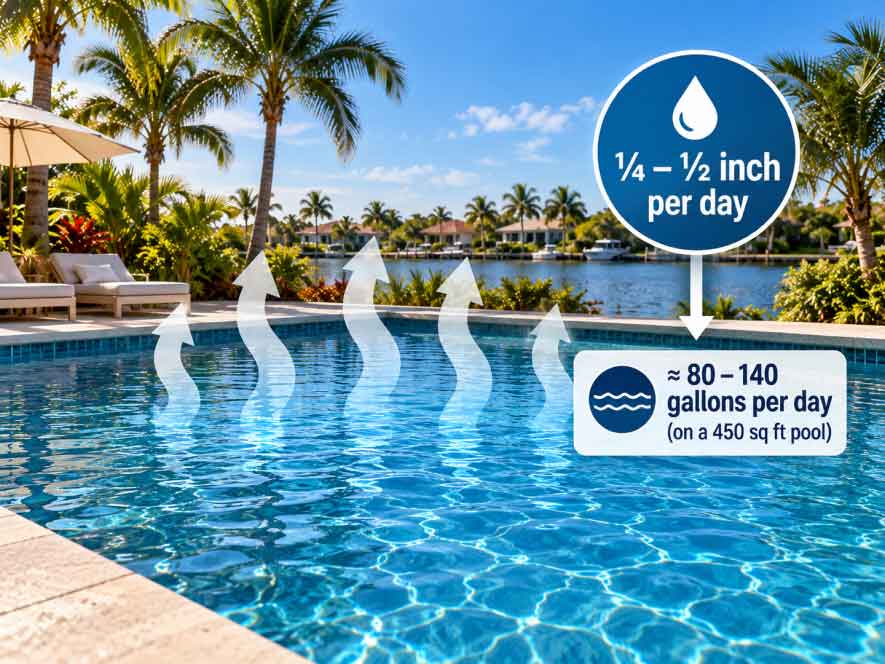
Uncovered outdoor pools lose water to evaporation. In humid subtropical climates that often runs about ¼–½ inch per day in peak season—roughly 80–140 gallons a day on a 450 sq ft residential pool. In drier, windier regions the same surface loses far more. Owners can control the losses that only look like evaporation on the bill.
The extra losses usually come from three places:
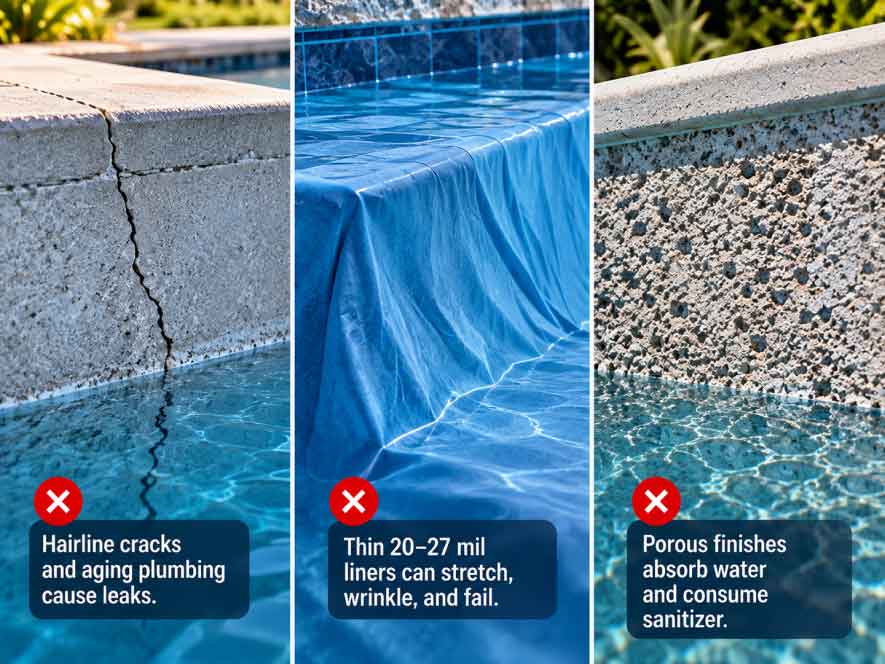
- Hairline cracks and aging plumbing in uninsulated concrete or gunite shells.
- Thin 20–27 mil vinyl liners that stretch, wrinkle, and fail at seams and corners.
- Porous cementitious finishes that soak water into the substrate and later force acid washes or resurfacing that often mean a partial or full drain.
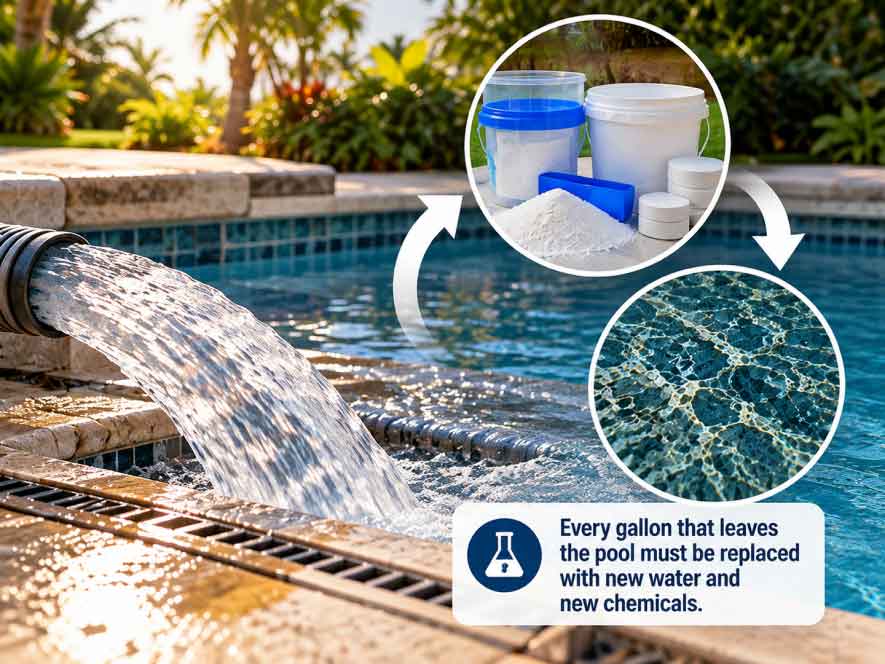
Every disappearing gallon has to be replaced. Makeup water brings new minerals. Evaporation leaves existing minerals and stabilizer behind. TDS and calcium climb until owners dump and refill. The water is gone twice: once as vapor or a leak, again as a deliberate drain.
Why Porous Finishes Waste Both Water and Chemistry
Plaster, pebble, and quartz finishes are not sealed the way a thick PVC membrane is. They absorb water and consume sanitizer. Chlorine that should stay in the water column instead reacts with the cementitious surface and the biofilm in its pores. Owners respond with more shock, more acid, and more brushing—then with a drain when the water becomes unmanageable.
A drain is the costliest water event a pool can have. A mid-size pool holds 15,000–25,000 gallons. That volume leaves the property, and a matching volume of municipal water comes back in. Every sanitizer, stabilizer, and salt already paid for goes with the old water. In drought years that is a restricted resource used to restart a finish that will demand the same cycle again.
How a Non-Porous Cefil 60-Mil Membrane Changes the Water Equation
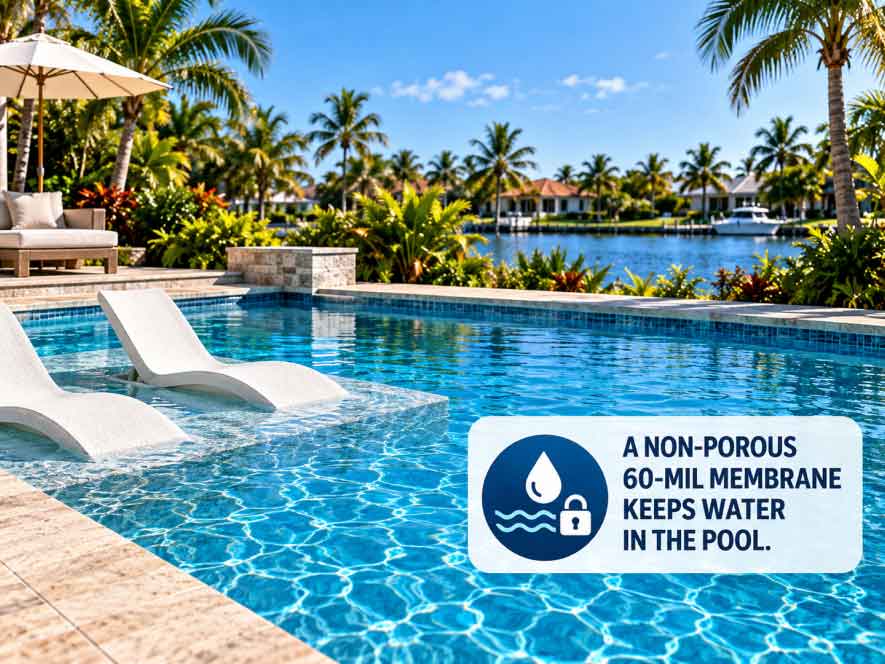
Cefil 60-mil membranes are three-layer, polyester-mesh-reinforced PVC sheets heat-welded on site into a continuous waterproof skin. The surface is a non-porous pool membrane. Water stays in the pool. Organics do not migrate into the wall. Sanitizer stays where it works—in the water—rather than being absorbed by the finish.
That changes three drought-relevant costs at once:
- Leak-related loss. A properly welded 60-mil membrane on a sound shell remains watertight for decades. The silent gallon-a-day leak that owners mistake for “just evaporation” drops off the operating budget.
- Chemical waste tied to water turnover. The membrane does not drink sanitizer and does not force periodic acid washes, so the same body of water stays in service longer. Fewer drains mean fewer times you discard already-treated water and repurchase chemistry.
- Makeup-water chemistry. Less unnecessary refill means less new hardness, metals, and alkalinity entering the pool. You fight concentration from genuine evaporation, not from a leak plus a porous wall.
The membrane is also why a renovation does not have to start with a tear-out. The pool is emptied, cleaned, and dried. Then Cefil 60-mil is cut and heat-welded over the existing plaster or fiberglass. The old bowl stays as the base. After the welds set, the pool is filled once into a new waterproof skin—instead of grinding off the finish, waiting on a new plaster coat, and repeating that drain-and-refill cycle every few seasons.
How ICF Insulation Supports a Drought-Ready Envelope
ICF construction stacks EPS foam forms, places steel, and pours a monolithic concrete core. The foam stays as permanent insulation on both faces of the wall. For water conservation the structural story matters as much as the thermal one.
Thermal cycling is hard on rigid shells. Hot days and cool nights expand and contract uninsulated concrete. Over years that movement opens micro-cracks that become leak paths. An ICF envelope dampens those swings. The shell stays more dimensionally stable, the welded membrane stays under even stress, and the pool remains a closed system instead of a slowly leaking tank.
A cover still cuts surface evaporation more than any other single habit—often 70–95% when used consistently. It works best on a pool that is already tight, which is what ICF plus a welded 60-mil membrane provides.
What the Combination Avoids Over 20 Years
Exact gallons depend on climate, wind, cover habits, and pool size. The pattern does not:
- One avoided full drain saves 15,000–25,000 gallons plus a complete chemistry restart.
- Two or three avoided thin-liner replacements save those drain events again.
- A leak-tight welded membrane removes the “mystery inch” that is not evaporation.
- A non-porous surface keeps sanitizer in the water instead of in the wall.
SAKKO POOL sells thick reinforced Cefil 60-mil membranes, repairs existing pools with those membranes, and builds new ICF pools with the membrane as the finished waterproofing layer. We build in Florida and supply Cefil nationwide.
A drought-ready pool is not a smaller pool. It is a tighter one: insulated structure, welded non-porous skin, fewer reasons to dump water, and chemistry that stays in service instead of going down the drain.
If you are planning a new build or facing a plaster pool that already needs frequent top-offs and periodic dumps, ICF plus Cefil 60-mil is a direct way to cut water loss, chemical waste, and refill cost.
Have Questions?
Talk to our specialist! Just fill out the form, and we’ll give you a call!
Have Questions?
Talk to our specialist! Just fill out the form, and we’ll give you a call!
FAQ
Other articles on this topic
Pool Overlay vs Tear-Out: When a 60-Mil Reinforced Membrane Wins
Custom Tanning Ledges: Why ICF + Cefil 60-Mil Beats Gunite & Thin Vinyl
Long-Term Pool Sustainability: ICF + Cefil 60-Mil for 20+ Years
Multi-Use Wellness Pools: ICF Structure + Cefil 60-Mil Membrane

Modern Pool Design: LED Lighting, Textures & 60-Mil Membranes