
Florida homeowners and designers are asking for infinity edges and raised spas more often than simple rectangular pools. These features create the resort look, but they also create the hardest details for traditional construction. Plaster and tile finishes rely on cold joints, thin overlays, and multiple material transitions. Those seams and transitions are exactly where Florida pools start to leak—especially when sandy soil moves, the water table rises, or a raised spa cycles between hot and cold.
At SAKKO POOL, a licensed pool builder in Palm Beach County, we solve the problem with two complementary systems: a monolithic Insulated Concrete Form (ICF) shell that carries the structural loads, and a site-welded Cefil 60-mil reinforced PVC membrane that seals every radius, overflow, and junction. The combination works for both new ICF builds and membrane overlays on existing bowls. The result is a watertight pool that keeps the architectural details without the maintenance cycle of plaster.

Why These Features Stress Traditional Finishes
Infinity edges and raised spas share three common challenges:
- Precise geometry that must stay level and stable for years
- Multiple elevation changes and radii where different materials meet
- Constant water movement or temperature differences that expose weak joints
Gunite or shotcrete shells are strong, but the finish is not. Plaster cracks at the weir wall of a vanishing edge and around jet penetrations in a raised spa. Once a crack opens, water migrates into the shell. In Florida’s high water table and sandy soils, that path often becomes a chronic leak.
A prefabricated thin vinyl liner is even less practical. Factory-made liners struggle with custom radii, spillover lips, and the irregular transitions these features require. The seams that do exist are vulnerable, and the material itself is too thin for high-traffic or high-use areas.
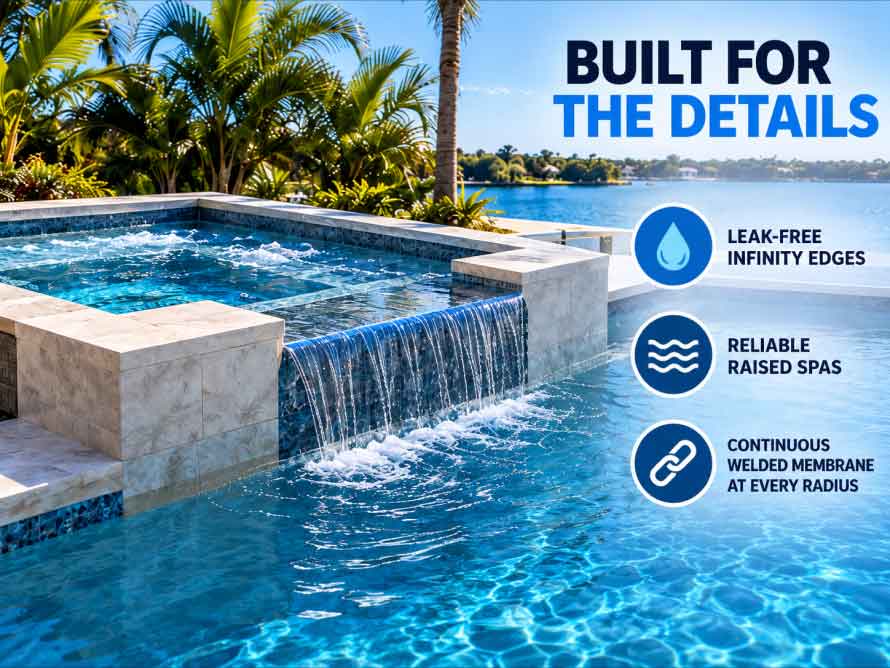
The Structural Role of the ICF Shell
ICF construction uses interlocking expanded-polystyrene forms that stay in place after the concrete is poured. The forms are stacked, reinforced with rebar, and filled in a single pour. The result is a continuous, insulated concrete wall system rather than a series of cold joints.
This monolithic character is especially useful for the features homeowners want now:
- An infinity or vanishing edge needs a perfectly level weir wall that does not settle or crack. Because the weir and the main shell can be poured together, the ICF system minimizes the cold joint that commonly appears where a traditional wall meets the floor or the overflow channel.
- A raised spa must support its own weight, the weight of the water, and the forces from hydromassage jets. The reinforced concrete core of an ICF wall provides that capacity while the permanent foam insulation helps the spa hold temperature with less energy.
The permanent insulation also reduces thermal cycling. In Florida, daily temperature swings can open hairline cracks in uninsulated concrete. The foam on both faces of an ICF wall dampens that movement, giving the membrane a more stable surface to seal against.
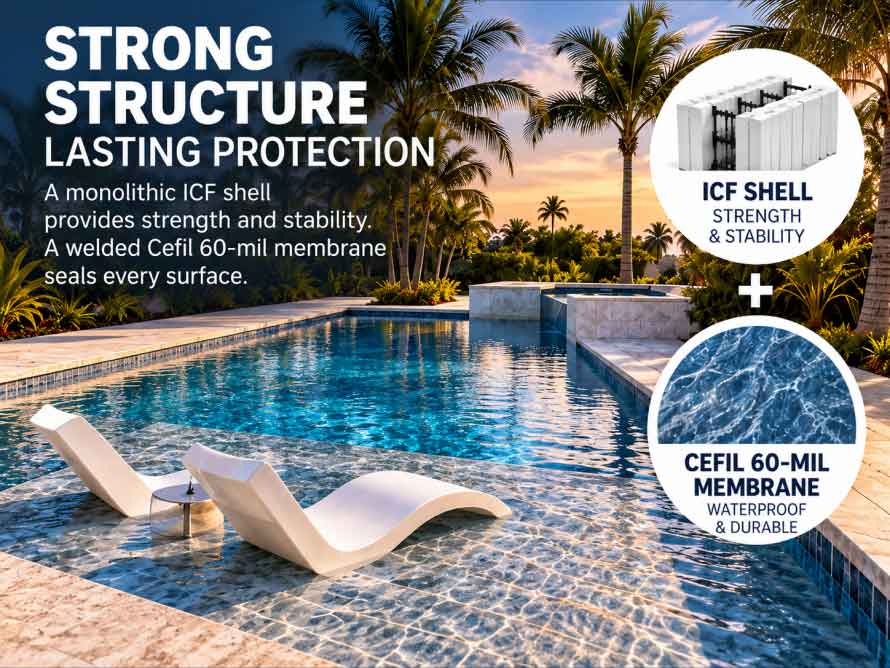
How a Welded Cefil 60-Mil Membrane Closes the Details
Once the structural shell is complete—or once an existing bowl has been cleaned and prepared—the Cefil membrane is installed. Cefil is a three-layer reinforced PVC: durable PVC faces bonded around a polyester mesh core. At 60 mil (1.5 mm) it is roughly twice as thick as a conventional residential vinyl liner and far more resistant to punctures and tears — a true heavy duty pool liner engineered for showcase architecture..
The critical difference is how it is installed. Sheets are cut on site and heat-welded into a continuous skin. There are no factory seams that must be stretched into place, and there are no plaster or tile joints that can open later. The membrane is flexible enough to follow radii and spillover lips, yet the polyester reinforcement keeps it dimensionally stable so it does not wrinkle or stretch out of shape.
Key advantages for these specific features include:
- Infinity and vanishing edges. The membrane can be welded right up to and over the weir detail. The overflow lip becomes a continuous, flexible surface instead of a brittle plaster edge that cracks when the water level or temperature changes. The catch basin and return lines are sealed at the same time, so water that leaves the main pool is collected cleanly and returned without finding a path into the shell.
- Raised spas. Hydromassage jets, seating benches, and spillover walls create many penetrations and elevation changes. The membrane is cut and welded around each jet housing and across every bench and step. Because the weld is continuous, the thermal cycling of the spa water does not open joints the way plaster does. The same membrane also forms the spillover that connects the spa to the main pool, eliminating the common leak point where two separate finishes meet.
In every case the membrane becomes the waterproofing layer. Any micro-movement in the shell or residual cracks from an older pool stay behind the liner. The surface the owner sees and touches remains smooth, non-porous, and free of the seams that traditionally fail.
New ICF Construction Versus Membrane Overlay
The same two-system approach works in two different project types.
- On a new ICF pool the forms, rebar, and concrete create the precise geometry first. Plumbing penetrations, jet lines, and lighting niches are set before the pour. After the shell cures, the Cefil membrane is welded over the prepared surface. The combination gives the owner both structural capacity and a finish that can be expected to last 20 or more years with normal care. Cefil carries a 10-year waterproofing warranty, and the non-porous surface reduces chemical demand and staining compared with plaster.
- On an existing pool the structural shell is already in place. If the bowl is still sound, it can be drained, cleaned, and prepared for a membrane overlay. The Cefil liner is then welded over the old plaster, tile, or fiberglass. This approach is particularly effective when the owner wants to add or restore an infinity edge or a raised spa without a full tear-out. The membrane seals the new or repaired details while covering existing cracks and discoloration. Installation typically returns the pool to service in days rather than the weeks required for plaster curing.
In both scenarios the owner avoids the cycle of plaster cracks, acid washes, and eventual resurfacing. The welded membrane also simplifies future color or texture changes. When the time comes, the old membrane is removed and a new one is installed in its place, without affecting the concrete shell.
Practical Benefits for Florida Projects
Florida conditions make the combination especially relevant. Sandy soils and a high water table put continuous pressure on any pool shell. Storms and heavy rain can temporarily raise groundwater around the pool. An ICF shell with a continuous welded membrane resists those forces better than a traditional finish that depends on multiple material joints.
Additional day-to-day advantages include:
- Predictable long-term performance rather than the variable lifespan of plaster or thin vinyl
- Lower chemical use because the non-porous surface does not absorb sanitizer or organics
- Easier cleaning and reduced algae growth compared with textured plaster
- A surface that stays comfortable underfoot in shallow areas and around seating
- The ability to choose from Cefil’s range of colors and textures, including options that mimic stone or concrete while remaining fully waterproof
- Predictable long-term performance rather than the variable lifespan of plaster or thin vinyl

Conclusion
Infinity edges and raised spas are no longer rare custom features. They are standard requests in new Florida projects. The details that make them attractive are also the details that traditionally leak. A monolithic ICF shell provides the structural strength and dimensional stability those features need. A site-welded Cefil 60-mil reinforced membrane then seals every radius, overflow, jet, and transition without the plaster seams that fail over time.
SAKKO POOL specializes in exactly this combination—ICF construction with Cefil membranes for new pools, and Cefil membrane overlays for renovations—throughout Florida and as the official U.S. representative of Cefil for builders nationwide. When the architecture calls for a vanishing edge or a raised spa, the structural system and the waterproofing layer can be designed to work together from the start. The result is a pool that looks like a resort and performs like a well-engineered system for decades.
Have Questions?
Talk to our specialist! Just fill out the form, and we’ll give you a call!
FAQ
Other articles on this topic
Florida Smart Pool Automation: ICF + Cefil 60-Mil Cut Bills 40–60%
Selling a Florida Pool: 60-Mil Membrane vs Plaster for Inspectors
Heat Pumps and Chillers on an ICF Pool: Smaller Equipment, Shorter Runtime

HOA and Light-Commercial Pools: The Plaster-to-Membrane Renovation Cycle
Renovating Steel-Wall & Panel Pools: Why Cefil 60-Mil Pool Liner Wins

Pool Insurance in Florida: Does ICF + 60-Mil PVC Change Claims
Drought-Ready Pools: ICF + 60-Mil PVC Cut Evaporation & Refill Costs
Pool Overlay vs Tear-Out: When a 60-Mil Reinforced Membrane Wins