
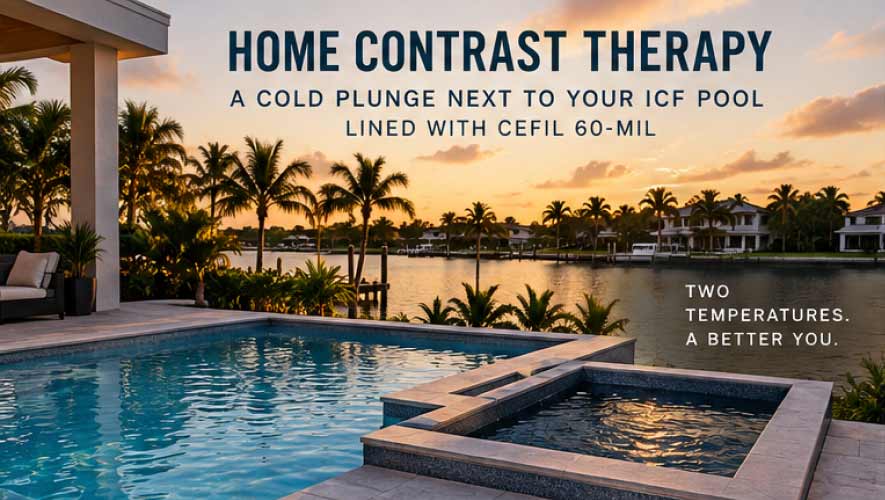
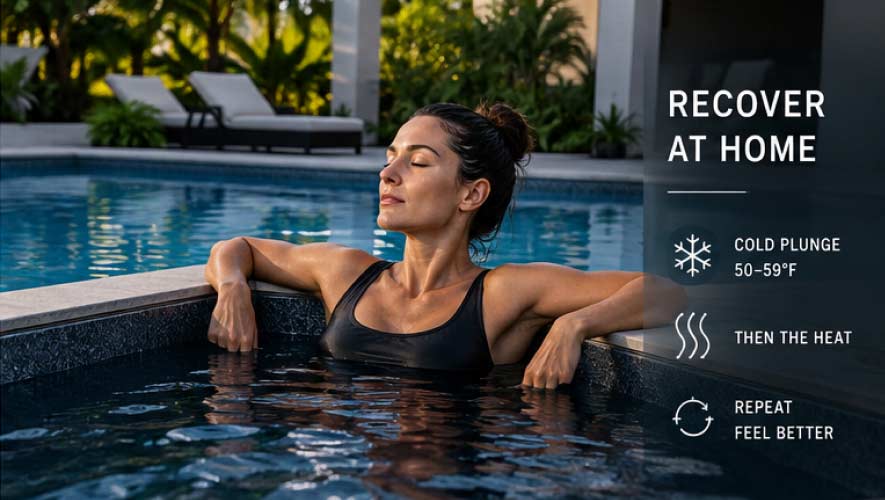
In 2026, recovery is no longer a gym add-on. Homeowners who already swim or soak want a second vessel: a compact cold plunge after heat, training, or the workday. Contrast therapy — cycling between warm water and a 50–59°F plunge — has moved from athletic facilities into residential backyards. The question is how to add that plunge next to an existing or new ICF pool without a leak-prone box that stresses the membrane.
A small insulated-concrete-form vessel finished with a Cefil 60-mil reinforced PVC membrane is the clean answer. SAKKO POOL, Cefil’s official U.S. representative and a licensed Florida ICF pool builder, supplies this pairing for full-size pools and for compact satellite plunges a few feet from the main basin.
Why a Separate Compact Plunge Beats Sharing the Main Pool
Lowering the water in a large ICF pool can create a temporary spa-style soak. It does not create a true cold circuit. Cold plunges work because the volume is small, the temperature is stable, and the session is short.
A separate ICF vessel gives you:
- A compact 6×8, 7×10, or 8×12 ft footprint (3.5–5 ft deep)
- Far less water than the swimming pool, so a chiller can hold 50–59°F without fighting 15,000–30,000 gallons
- Independent chemistry and temperature: the main Cefil-lined pool stays in the swimming range, the plunge stays cold
- A few-step circuit from heat to cold and back
ICF fits that small footprint:
- EPS forms stack quickly
- Rebar and a concrete core create a monolithic shell
- The finished wall is smooth and insulated — no tile or plaster required
- On compact Florida lots, and tighter yards anywhere in the U.S., excavation, forming, and membrane welding stay modest compared with adding another gunite spa
ICF Insulation Works in Both Directions
Most pool conversations treat insulation as a heating story. For contrast therapy it is a holding story. The continuous foam faces of an ICF wall reduce heat transfer through the shell.
What that means in practice:
- The main pool needs less heater runtime
- Chilled plunge water warms more slowly from soil and air
- The vessel behaves like a thermos in reverse: less energy to stay cold, more stable temperatures from morning to evening
That matters in Florida heat as much as in cooler states. A thin-walled tub sitting in 90°F air will climb out of the recovery range between uses. An ICF plunge shares the same logic as the main pool:
- A stable concrete core
- Foam on both faces
- A flexible waterproof skin
Why Cefil 60-Mil Handles Hot–Cold Cycling
A cold plunge is not a gentle environment. Users enter and exit often. Water is colder than a standard pool. Sanitizer demand per gallon can run higher because the volume is small. Thin residential vinyl is the wrong surface for that cycle.
For an inground pool liner, that reinforced construction matters: Cefil’s 60-mil (1.5 mm) PVC membrane uses a three-layer structure designed for demanding pool environments:
- PVC faces
- A polyester mesh core
- A UV-stable acrylic topcoat with antibacterial treatment
Heat-welded on site, it forms a continuous waterproof layer that flexes with the ICF shell instead of cracking at corners and benches.
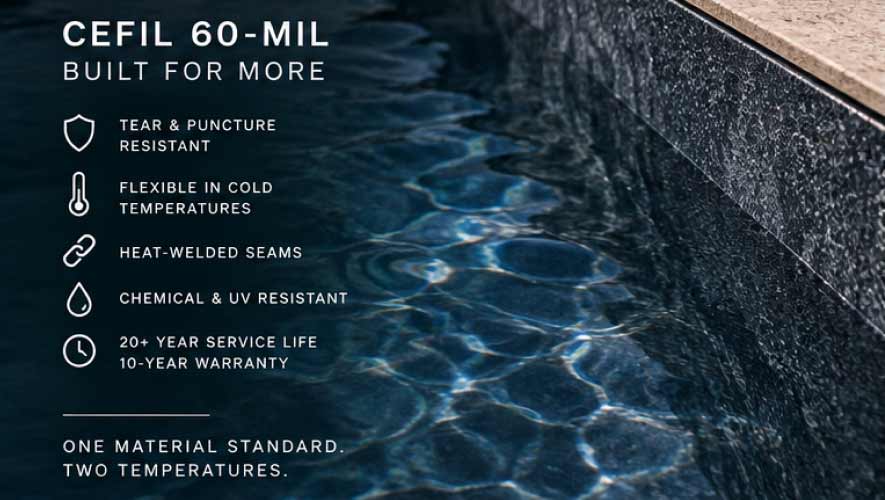
Those traits map to daily plunge use:
- Tear and puncture resistance. The mesh core is several times stronger than thin liners. Steps, benches, and frequent entry do not stretch the sheet thin at folds.
- Flexibility in the cold. Reinforced PVC remains workable at low water temperatures and does not turn brittle the way some rigid finishes do in the 50s.
- Thermal cycling at the seams. Welded joints tolerate repeated temperature change better than plaster or tile. The plunge is its own vessel, so no shared wall must be hot on one face and cold on the other.
- Chemical and UV resistance. With balanced water, the surface resists fading and staining under Florida sun.
- Service life. With proper care these membranes commonly last 20+ years and carry a 10-year warranty.
The same membrane that lines the main ICF pool can line the plunge. One material language, two temperatures.
Dark Cefil Collections: The Look People Want in 2026
Contrast therapy spaces feel different from a bright family pool. Homeowners want depth, a lagoon or stone-cut appearance, and water that reads dark and still.
Strong options for a compact plunge:
Dark membranes hide the visual busy of a small vessel: benches, steps, and the waterline read as one surface.
Color is not a substitute for insulation. Dark liners can absorb a modest amount of solar energy; they do not replace ICF foam or a cover when the goal is to hold 50–59°F. Treat color as design:
- Choose the dark collection for character
- Rely on the insulated shell, a cover between sessions, and a correctly sized chiller to hold temperature
- Specify anti-slip textures from Passion, Nature, Victoria, or Onyx on steps and benches
- Use a Class C wet-surface rating on steps — practical, not decorative
Chemistry and Temperature Cycles Without Harming the Membrane
Cefil membranes are chemical-resistant. They are not chemical-proof if the water is ignored. A compact plunge makes imbalance show up faster because there are fewer gallons to dilute a mistake.
Keep the same ranges SAKKO POOL recommends for any 60-mil PVC pool:
- pH: 7.2–7.6
- Total alkalinity: 80–120 ppm
- Calcium hardness: typically 175–300 ppm
- Free chlorine: 1–3 ppm
- Cyanuric acid: 30–50 ppm when using stabilized chlorine
Mistakes that damage the membrane:
- Low pH slowly attacks the surface and encourages fading
- High pH leaves scale that dulls dark collections first
- Excess chlorine or undissolved shock sitting on the floor bleaches the sheet
- Copper-based algaecides leave blue-green stains
- Acid or dry chemicals poured against the wall or into the skimmer wash down the liner
Two operating rules matter more on a plunge than on a large pool:
- Separate systems when possible. Dedicated circulation, sanitizer, and temperature control keep the cold vessel from sharing water with a heated spa or a high-chlorine swim pool. If a salt system is used, follow the same stabilizer and off-season rules: a covered, unused plunge with the chlorinator still running will overshoot and discolor the sheet.
- Respect the membrane’s temperature envelope. Cefil’s maintenance guidance sets a maximum water temperature of 32°C (about 90°F) for warranty conditions. Higher heat accelerates chemical attack and fading. That limit belongs on the hot side of the circuit — the spa or heated pool — not on the plunge. Cold water is not the stress case.
A cover between sessions cuts debris, UV load, and temperature drift. Brush and vacuum the small vessel the same way as the main pool; the non-porous surface does not harbor algae the way plaster does.
How to Place the Plunge Next to the ICF Pool
The strongest layouts treat the two vessels as one deck.
Typical arrangements:
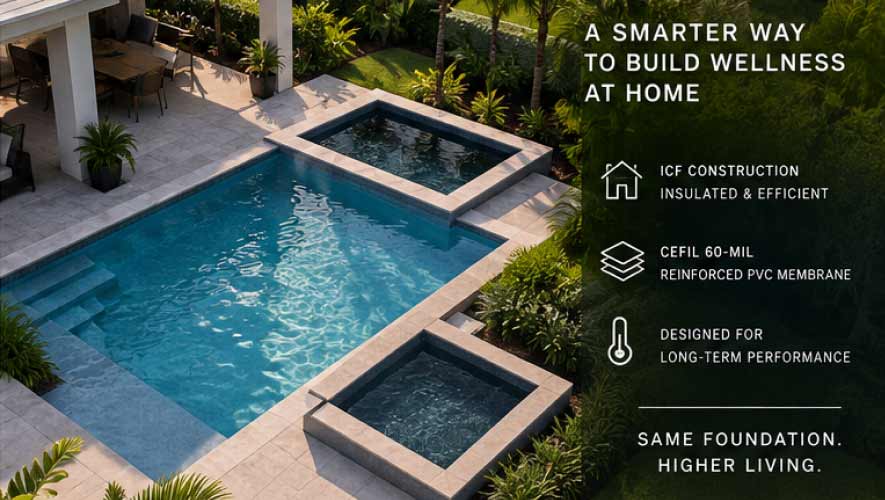
- A compact ICF plunge parallel to the shallow end or tanning ledge, with 3–6 ft of shared coping so the step from warm to cold is a few paces
- A raised or semi-raised plunge that shares a wall line with the pool deck, useful when the lot already has an ICF pool and limited extra excavation room
- Matching Cefil color on both vessels for one material story
- A dark plunge against a lighter pool so the recovery zone is visually distinct
Planning notes:
- Plumbing, bonding, and equipment pads should be planned with the original ICF pool, not added as an afterthought
- New-build projects can form both shells in the same ICF campaign
- Existing ICF + Cefil pools can take a satellite plunge without touching the original membrane
- Existing gunite or fiberglass pools can still receive a compact ICF plunge with the same insulated shell and 60-mil finish
Build the Circuit on the Same Foundation as the Pool
SAKKO POOL specializes in ICF block construction and in supplying and installing Cefil 60-mil reinforced PVC membranes nationwide. The same pairing used for long-life residential pools scales down cleanly to a compact cold plunge:
- Insulated ICF shell
- Cefil 60-mil reinforced PVC membrane
- Heat-welded seams
Planning a new ICF pool with the plunge formed in the same build, or adding a dedicated cold vessel next to a Cefil-lined pool? Contact SAKKO POOL to match vessel size, dark collection, equipment, and chemistry to your site. The goal is a backyard circuit that holds temperature, water, and finish — heat on one side, cold on the other, same membrane standard on both.
Have Questions?
Talk to our specialist! Just fill out the form, and we’ll give you a call!
FAQ
Other articles on this topic
Custom Tanning Ledges: Why ICF + Cefil 60-Mil Beats Gunite & Thin Vinyl
Long-Term Pool Sustainability: ICF + Cefil 60-Mil for 20+ Years
Multi-Use Wellness Pools: ICF Structure + Cefil 60-Mil Membrane

Modern Pool Design: LED Lighting, Textures & 60-Mil Membranes

The True Cost of Owning a Pool: ICF & 60-Mil PVC ROI Explained