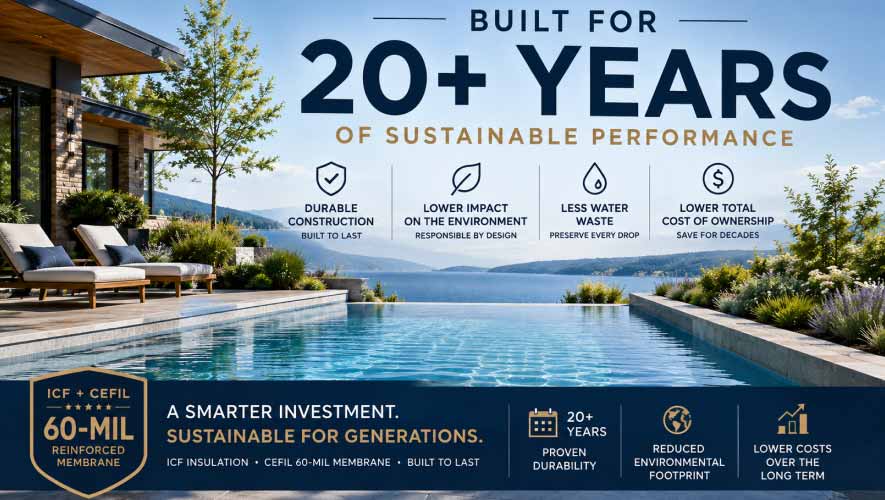
When people talk about “energy-efficient” or “environmentally friendly” pools, the conversation often stops on the day the pool is finished. Real sustainability shows up later—year after year, decade after decade—in lower energy bills, fewer gallons of make-up water, reduced chemical demand, and far fewer major interventions.
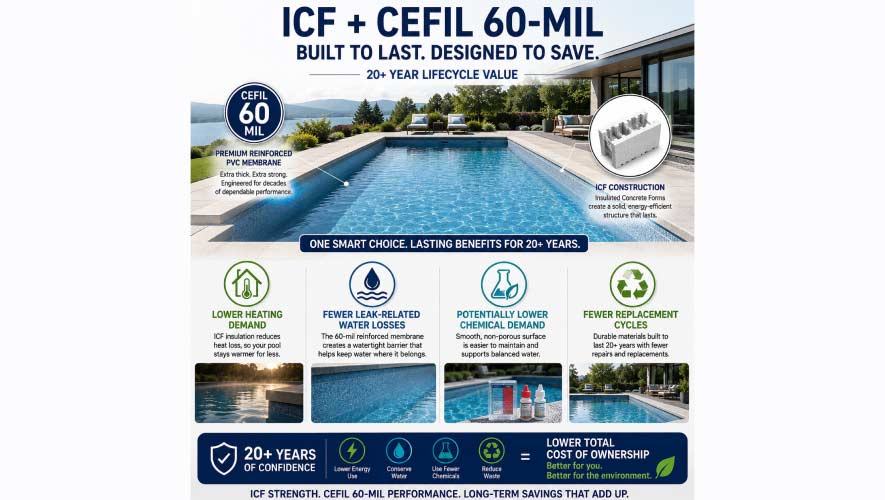
An Insulated Concrete Form (ICF) shell paired with a Cefil 60-mil reinforced PVC membrane is engineered for exactly that long horizon. This is where modern luxury swimming pool construction diverges from conventional builds: the combination delivers measurable reductions in energy, water, and chemical use across a 20- to 30-year service life, turning what is usually a high-consumption amenity into a lower-impact, lower-cost asset.
The Lifecycle Reality of Conventional Pools
Traditional gunite or thin-liner pools lose heat rapidly through uninsulated walls and floors. Industry data consistently show that 60–80% of heat loss can occur through the shell into the surrounding soil. Heaters therefore run longer and more often. Thin 20–27 mil vinyl liners typically need replacement every 5–10 years; each change means draining, disposal of the old material, new manufacturing and shipping impacts, and additional water and chemical use to rebalance the pool. Surface finishes such as plaster or tile can crack, leach, or require resurfacing, further increasing resource consumption.
Over two decades these recurring events compound into higher operating costs and a larger environmental footprint than the original construction numbers suggest.
How ICF Insulation Cuts Energy Demand for Decades
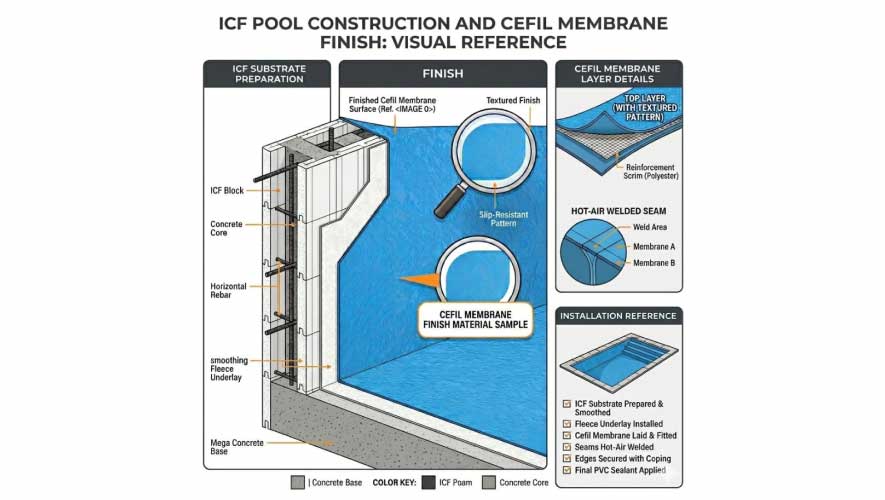
ICF construction places continuous expanded polystyrene (EPS) foam on both faces of a reinforced concrete core. The result is a high-R-value thermal envelope (commonly R-20 to R-22 or higher depending on the block system) with almost no thermal bridging. Heat stays in the water instead of migrating into the ground.
Documented results include:
- Heat-loss reductions of up to 60% or more compared with uninsulated concrete shells when the floor is also insulated.
- Noticeably more stable water temperatures, so heaters cycle less frequently.
- Lower seasonal heating costs—commonly cited in the 40–60% range depending on climate, cover use, and equipment.
- An extended comfortable swimming season without proportional increases in energy use.
Because the insulation is permanent and integral to the structure, these savings repeat every year for the life of the pool. Over 20+ years the cumulative energy reduction is substantial, lowering both utility costs and the associated carbon emissions from heating.
The Cefil 60-Mil Membrane: Durability That Protects Water and Chemistry
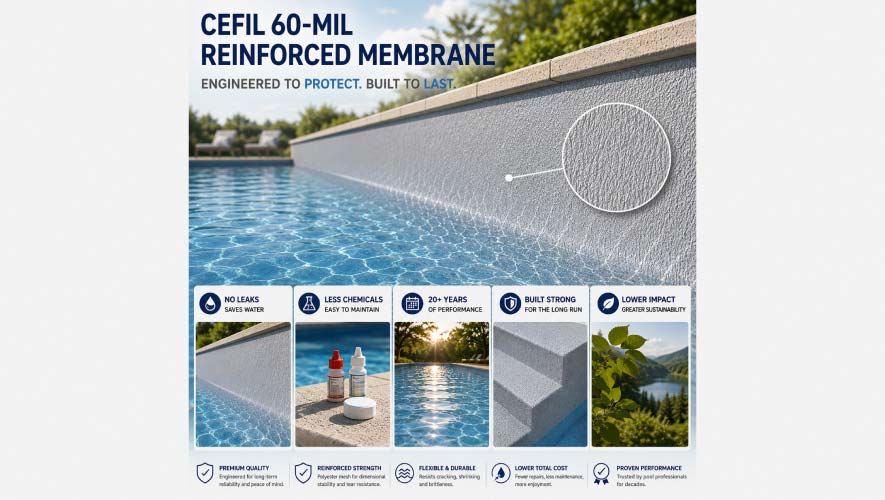
Cefil 60-mil membranes are polyester-mesh-reinforced, three-layer PVC systems engineered as a truly high-quality pool liner built for long service. Properly installed and maintained, they routinely deliver 20–25+ years of performance—often with a 10-year waterproofing warranty that reflects real-world expectations far beyond thin vinyl liners.
Key long-term advantages include:
- Exceptional puncture, tear, and chemical resistance. The reinforced structure maintains integrity even if the underlying concrete develops minor cracks.
- UV stabilizers and protective lacquer that resist fading, embrittlement, and surface degradation under sun and chlorine or salt exposure.
- A smooth, non-porous surface with antimicrobial properties that discourages biofilm and algae attachment.
- Dimensional stability across temperature swings, reducing wrinkles and dirt traps that increase cleaning and chemical demand.
Because the waterproofing layer remains intact for decades, leaks are rare. That alone conserves large volumes of water that would otherwise be lost and then replaced. The stable, easy-to-clean surface also reduces the frequency and quantity of sanitizers, pH adjusters, and algaecides required to keep water balanced. Industry observations and owner experience with quality reinforced membranes point to chemical-use reductions commonly in the 30–50% range relative to more reactive or porous finishes.
Quantifying the 20+ Year Savings Profile
Exact numbers vary with pool size, climate, heating method, cover habits, and local utility rates, yet the directional picture is consistent:
- Energy: Annual heating-cost reductions of hundreds to low thousands of dollars compound into five-figure savings over two decades while cutting greenhouse-gas emissions tied to electricity or gas.
- Water: Elimination or sharp reduction of leak-related losses plus lower evaporation pressure from more stable temperatures and easier cover use conserve thousands of gallons per year in many climates.
- Chemicals: Lower demand means fewer products purchased, transported, and ultimately introduced into the water system and surrounding environment.
- Material cycles: Avoiding two or three full thin liner replacements (or major resurfacing projects) eliminates the embodied energy, manufacturing waste, and disposal impacts of those interventions.
When these factors are added together, the higher initial investment in an ICF shell and Cefil 60-mil membrane is frequently offset by lower total cost of ownership and a measurably smaller ecological footprint across the pool’s useful life.
Beyond “Energy-Efficient” Labels
Many modern pool systems claim energy efficiency through efficient pumps, heat pumps, or covers. Those measures are valuable. ICF + Cefil 60-mil construction multiplies their effect by attacking heat loss at the source and by creating a durable, chemically stable envelope that needs less intervention. The result is not a one-time efficiency gain but sustained performance that continues to deliver savings long after the novelty of new equipment has worn off.
The same durability that protects the owner’s investment also reduces the environmental burden of repeated manufacturing, shipping, installation, and disposal of short-lived finishes.
Built for the Long Run
SAKKO POOL specializes in the sale of Cefil 60-mil reinforced membranes, professional installation on both new and existing pools, and complete ICF pool construction that pairs the insulated shell with this long-lasting waterproofing system. The approach is deliberately focused on lifecycle performance rather than short-term price.
A pool that uses less energy every season, loses less water to leaks and unnecessary top-ups, and requires fewer chemicals for decades is simply more sustainable. The numbers over 20+ years make the case clearer than any single “green” feature ever could.
If you are planning a new pool or evaluating a renovation, consider the full operating horizon. The combination of ICF insulation and a Cefil 60-mil membrane is one of the most practical ways available today to reduce the real environmental cost of owning a pool for the next generation of owners.
Have Questions?
Talk to our specialist! Just fill out the form, and we’ll give you a call!
FAQ
Other articles on this topic
Multi-Use Wellness Pools: ICF Structure + Cefil 60-Mil Membrane
Modern Pool Design: LED Lighting, Textures & 60-Mil Membranes
The True Cost of Owning a Pool: ICF & 60-Mil PVC ROI Explained

Family Pool Design with ICF & 60-Mil PVC Membrane: Safe for All Ages
Future-Proof Pool Design: Materials for Extreme Weather Across the US